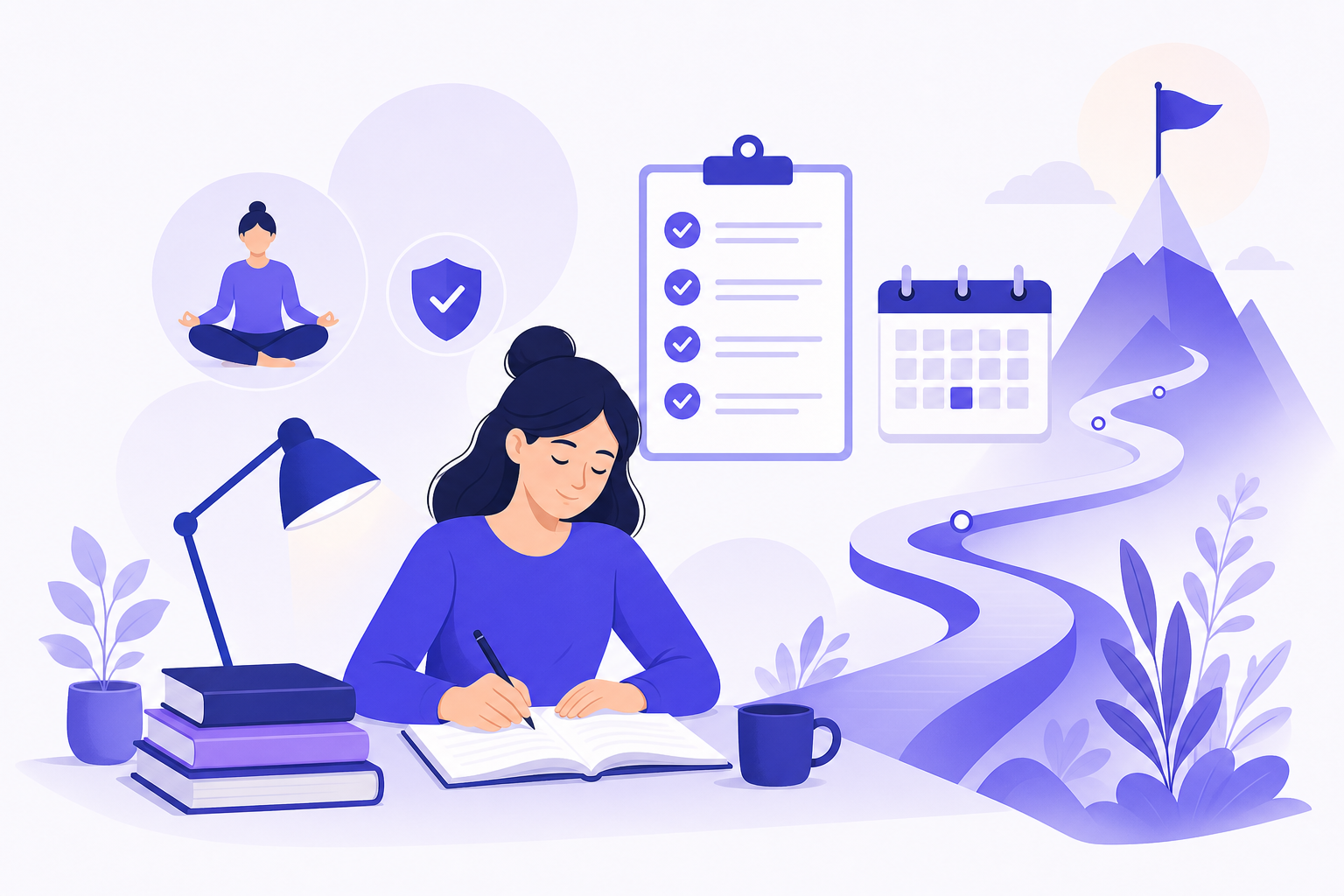
The most reliable way to overcome test anxiety is to combine thorough, active exam preparation with techniques that calm your body and thoughts, plus enough sleep. A little tension is normal and even useful – it is only when anxiety genuinely blocks you that professional support is also worth seeking.
What is test anxiety – and is it normal?
Test anxiety is a situation-specific anxiety that arises because your performance is being evaluated. It shows up on two levels: physically (racing heart, sweaty hands, shallow breathing, a knot in your stomach) and mentally (rumination, self-doubt, and in the worst case the dreaded "blackout"). It is very common – according to the psychological counselling service of Freie Universität Berlin, around 40% of students experience it as a serious burden. And it affects far more than university students: pupils, apprentices and people in further education feel it just as much.
One thing is important to know: a certain amount of tension is completely normal and not a flaw. It keeps you alert and focused. Test anxiety only becomes a problem when it grows so strong that it paralyses your thinking or weighs on you for weeks. The good news: test anxiety is highly manageable – with the right strategies it can be reduced substantially in the vast majority of cases.
Why does strong test anxiety block you?
Researchers distinguish two components of test anxiety: physical arousal (a pounding heart, trembling) and worried thoughts about possible failure. It is mainly the worried thoughts that hurt performance, because they occupy exactly the part of your working memory that you actually need to calculate, recall and put things into words. That is why a blackout feels as if "everything is gone", even though you really do know the material.
Experts often picture the relationship as an inverted U: too little tension leaves you sluggish, too much overwhelms you – and in between, at moderate arousal, you perform best. So the goal is not to switch off every bit of nervousness, but to bring it down to a helpful level and free up your mind for the task.
How do I overcome test anxiety? Six strategies
1. Learn actively, not passively
The most effective "anxiety medicine" is solid preparation – but not every study method works equally well. Simply rereading or highlighting the material mostly creates a false sense of security: you recognise the text and mistake that for knowing it. Far better is active recall (retrieval practice): quizzing yourself, working with flashcards, answering questions from memory. In a study run over more than ten years in schools, 72% of pupils reported that regular self-testing reduced their test anxiety (Agarwal et al., 2014). The reason: your confidence aligns with what you actually know, instead of resting on a vague gut feeling.
Amplify this effect by starting early and spreading the material across several days (spaced practice). Several short study sessions with breaks in between anchor knowledge more durably than a single marathon just before the exam – and they take away the pressure of having to master everything at once. And if only a little time is left, a tight study plan for the last week before the exam helps.
2. Rehearse the real thing beforehand
Anxiety feeds on the unknown. So simulate the exam as realistically as possible: work through past papers under time pressure, give practice presentations, and for oral exams say your answers out loud with another person. The more often you have rehearsed the situation, the less it surprises you on the day: what you have already been through several times sets off less alarm. Tools that automatically turn your own notes into flashcards, quiz questions or a simulated oral exam – such as LearnCastAI – take the tedious job of preparing that practice material off your plate.
3. Calm your body: breathing and relaxation
When your pulse climbs, breathing helps fastest. Breathe calmly through your nose deep into your belly and let the air out noticeably more slowly – a longer exhale dampens the body's alarm response. A simple pattern: breathe in for about four seconds, out for six to eight, for a few minutes. Regularly practised techniques such as autogenic training, progressive muscle relaxation, yoga or meditation also lower your overall tension; both FU Berlin and Germany's Federal Employment Agency recommend them. One caveat: relaxation techniques work best when you practise them beforehand – not for the first time in the exam room.
4. Reframe your thoughts
Test anxiety is fuelled by catastrophic thinking: "If I fail, everything is over." You can deliberately replace such sentences with more realistic ones: "This exam matters, but it is not my whole life – and I have prepared." It also helps to stop fighting the anxiety and instead accept it as a normal and appropriate reaction. A short, positive self-instruction – "I have studied, I'll just start with the first question" – often works better than the hopeless attempt to become completely calm. It can also help to write down your typical anxious thoughts before the exam and note a factual counter-question next to each, for example: "How often has the feared worst case actually happened?"
5. Sleep enough – and regularly
Sleep is not lost study time; it is part of learning: while you sleep, your brain consolidates what you took in during the day. A study by Okano and colleagues (2019) found that sleep duration, quality and consistency together explained nearly a quarter of the differences in grades – and that it was above all the sleep in the week and month before the exam that counted, not just the final night. Pulling an all-nighter is therefore usually a bad deal: you gain a few hours and lose focus, memory and composure. Schedule fixed sleep times during the study phase too, and treat them like an important appointment.
6. On exam day itself
Arrive in good time so no extra time pressure builds up. First get an overview of all the questions and start with an easy one – quick wins lower your tension. If a blackout does strike, pause briefly, breathe out consciously a few times and then return to the task. A blackout is almost never the end, just a temporary block.
Which mistakes make test anxiety worse?
Some habits stoke anxiety needlessly. Watch out for these traps in particular:
- Procrastinating: Avoiding preparation brings brief relief – and increases the pressure afterwards.
- Only reading and highlighting: It feels productive but barely cements your knowledge.
- Leaving everything to the last minute: Cramming overnight rarely produces stable, retrievable knowledge.
- Constantly comparing yourself: Watching seemingly confident classmates only feeds your own doubts.
- Too much caffeine: Large amounts can amplify a racing heart and jitters rather than calming them.
When should I seek professional help?
This article is not a substitute for counselling or treatment. Get support if anxiety dominates your thoughts for long stretches, weighs heavily on your body, leads to panic or repeated blackouts, or if self-help simply is not enough. Good places to turn are the psychological counselling services of universities and student unions, your family doctor, and – in Germany – the appointment service line 116117, which arranges a free psychotherapeutic consultation. Many universities also offer free workshops and short counselling sessions specifically on coping with test anxiety – a low-threshold first step for which you need no diagnosis. Reaching out for help is a sign of good judgement, not of weakness.
Conclusion
You do not overcome test anxiety by fighting it, but by preparing with confidence, calming your body and turning up well rested. Start active recall early, rehearse the real thing and plan your sleep deliberately – and get help if the anxiety grows too large. And if you want to turn your own study material into flashcards, quizzes and mock exams for that, LearnCastAI's AI exam coach can make the preparation easier.
Sources
- Practical tips to reduce student test anxiety — RetrievalPractice.org (Pooja K. Agarwal; Agarwal et al., 2014)
- Prüfungsangst verstehen und bewältigen (Understanding and coping with test anxiety) — Freie Universität Berlin – Psychological Counselling
- Sleep quality, duration, and consistency are associated with better academic performance in college students — npj Science of Learning (Okano et al., 2019)
Frequently asked questions
Yes. A certain amount of tension is completely normal and can even sharpen your focus; around 40% of students experience test anxiety as a serious burden. It only becomes a problem when it blocks your thinking or weighs on you heavily for weeks.
In the short term, slow belly breathing with a longer exhale and deliberately reframing catastrophic thoughts help most. The strongest long-term lever is thorough, active preparation with regular self-testing instead of merely rereading.
When anxiety dominates your thoughts for long stretches, weighs heavily on your body, leads to panic or repeated blackouts, or when self-help is not enough. Turn to university psychological counselling services, student unions, or in Germany the number 116117.
Worried thoughts about possible failure occupy exactly the part of your working memory you need to calculate, recall and put things into words. That is why a blackout feels like everything is gone, even though you actually know the material. You perform best at moderate arousal — too little tension leaves you sluggish, too much overwhelms you.
Sleep is part of learning, not lost study time: while you sleep, your brain consolidates what you took in during the day. A study by Okano and colleagues (2019) found that sleep duration, quality and consistency together explained nearly a quarter of the differences in grades, with the sleep in the week and month before the exam mattering most, not just the final night.
Enjoying LearnCastAI? Tell Google.
 Add as preferred source