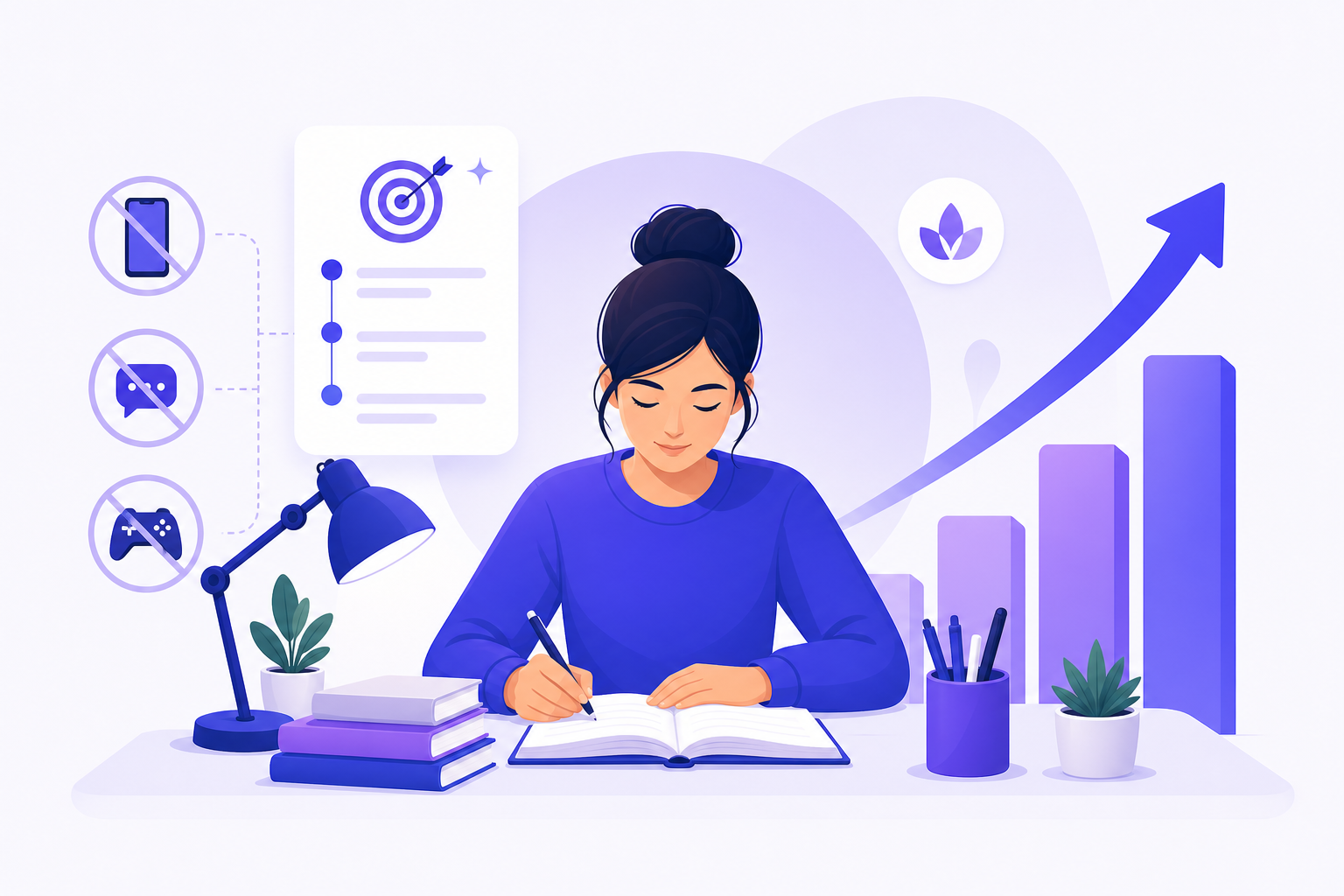
You reduce digital distraction while studying most effectively by removing its triggers rather than fighting them every single time: silence your phone and put it out of reach, switch off notifications, close needless tabs, and work in fixed, undisturbed blocks. The lever is not more willpower but an environment in which the distraction never shows up in the first place.
What is digital distraction while studying?
Digital distraction is any interruption from a device or app that pulls your attention away from the material — the buzzing message, the glance at social media, the second screen with a video running in the background. It has two sides: external distraction (a signal from outside, such as a ring tone) and internal distraction (the urge to check for yourself whether something new has arrived). Both are harmless if they happen once a day. They become a problem because, while you study, they occur minute by minute — and because each single interruption costs far more than the few seconds the glance at the screen takes.
Why is it so hard to resist the phone?
Because it isn't about your self-discipline — it's about design. Social apps and messengers rely on what psychologists call intermittent reinforcement: the reward — a like, a new message, an interesting post — arrives irregularly and unpredictably, much like a slot machine. It is precisely this unpredictability that makes checking so tempting. Every notification is, on top of that, a cue that sets off an ingrained habit loop: stimulus, reach for the device, brief reward. So if you keep catching yourself while studying, you are not weak-willed — you are up against a system built to be opened. That is why removing the trigger is more promising than trying to be stronger in each individual moment.
Why does a quick glance at the phone cost more than a few seconds?
Because your attention does not return with your gaze. In 2009 the organisational psychologist Sophie Leroy described a phenomenon she calls "attention residue": when you interrupt a task, part of your attention stays stuck on the old activity — even once you have already turned to the new one (Leroy, Organizational Behavior and Human Decision Processes, 2009). After every switch it takes time before you are fully back with the material, and during that transition you work more slowly and more shallowly. The brain cannot switch at the push of a button; it has to rebuild the context first.
For studying that means: the ten-second glance at a message costs you not ten seconds but, on top of that, the time to find your way back into the text — plus the quality lost during that phase. Anyone who checks "just quickly" twenty times an hour never reaches the depth at which understanding and retention even begin. That is exactly why undisturbed, focused work as a student (deep work) is so much more productive than constantly chopped-up studying: what counts is not the sum of the minutes but how deeply you are inside them.
How much does the mere presence of the phone disrupt you?
Surprisingly much — and without you touching it at all. In 2015 Cary Stothart and colleagues showed that merely receiving a notification measurably worsened performance on an attention-demanding task, even when participants never picked up the phone. The disruptive effect was comparable to the one produced by actually making a call or texting (Stothart et al., Journal of Experimental Psychology: Human Perception and Performance, 2015). The reason: the signal alone triggers thoughts — "Who was that? What do they want?" — and this mind-wandering draws resources away from learning.
One related claim, though, calls for honesty. A much-cited study ("Brain Drain", Ward et al. 2017) suggested that the mere presence of the phone on the table lowers mental capacity. A 2023 meta-analysis, however, found this effect only small and inconsistent — discernible for memory, weaker and partly non-significant for attention, with striking differences between world regions. So the robust lesson is not that a switched-off phone next to you paralyses your brain. It is more concrete: it is the notifications and the urge to check that reliably fragment your attention. And you switch off both most easily by silencing the device and taking it out of sight.
How do you set up a low-distraction study environment?
The environment decides more than the good intention. These steps lower the friction before the distraction even arises:
- Silence the phone and put it in another room. Not just face-down — out of reach. What you cannot see and cannot grab within two seconds triggers the urge less often.
- Switch off notifications. Turn on a focus or do-not-disturb mode for your study time. Every suppressed alert is an interruption that never happens.
- Keep only the tabs you need open. Close everything that doesn't belong to the material; a website blocker for social media during your blocks takes the decision off your hands.
- Mind your surroundings. In 2013 Faria Sana, Tina Weston and Nicholas Cepeda found that not only did the multitasker score lower, but so did the students who had someone else's multitasking laptop in their field of view (Computers & Education, 2013). In the library, sit so that no other screens are flickering in your line of sight.
- Fixed blocks with a clear start and end. A defined time frame makes "not now" the default answer to every distraction.
If you want to go deeper into how focus can be trained on purpose, you'll find fitting approaches on how to deliberately improve your focus.
Which focus techniques help against distraction?
Techniques don't replace a good environment, but they give it structure:
- Time-boxing with the Pomodoro technique. You work a fixed stretch — classically 25 minutes — with focus on one thing and then take a short break. The trick is not the number but the deal you make with yourself: within the block, you don't switch.
- Park distractions instead of chasing them. If an "I should just quickly …" pops into your mind mid-study, write it on a slip of paper and keep learning. The thought is noted, demands no more attention — and you stay with the material.
- Batch your messages. Answer messages together during breaks, not spread across the whole session. A single deliberate check per break replaces twenty reflexive ones.
- One thing at a time. Music without lyrics can help; a second screen with video almost always hurts. Real multitasking doesn't exist while studying — only fast, expensive jumping back and forth with exactly the attention residue described above.
How does the phone turn from distractor into tool?
The device that distracts you is at the same time one of the most powerful learning tools you have — it depends on what you switch it on for. Instead of scrolling through feeds on the train, you can use that same dead time to study. This is exactly where LearnCastAI comes in: it turns your own material into a learning podcast you can use to keep learning on the go with audio. That way screen time which would otherwise eat your attention becomes a session that uses it — with no feed, no like, no notification.
Conclusion: environment beats willpower
You don't defeat digital distraction with more discipline but with less opportunity. Take the triggers away from the phone — silent, out of sight, notifications off — protect your blocks from other people's screens, and schedule fixed focus time. The quick glance is never quick; attention residue makes it expensive. If you're looking for more strategies for efficient studying, you'll find them in our productivity category. And if you want to flip your screen time around, a learning podcast can turn waiting time into learned material.
Sources
- The attentional cost of receiving a cell phone notification — Journal of Experimental Psychology: HPP (Stothart, Mitchum & Yehnert, 2015)
- Why is it so hard to do my work? The challenge of attention residue when switching between work tasks — Organizational Behavior and Human Decision Processes (Leroy, 2009)
- Laptop multitasking hinders classroom learning for both users and nearby peers — Computers & Education (Sana, Weston & Cepeda, 2013)
- Does the Brain Drain Effect Really Exist? A Meta-Analysis — Behavioral Sciences / PMC (meta-analysis of Ward et al. 2017)
Frequently asked questions
Out of sight and out of reach works far better than just face-down. Research shows that even a received notification disrupts attention (Stothart et al., 2015) — what you neither see nor can grab within two seconds triggers the urge to check less often. Another room plus silencing is the safest option.
Because of "attention residue": after an interruption, part of your attention stays stuck on the old activity, and you need time to get fully back into the material (Leroy, 2009). So the ten-second glance costs the extra re-entry time plus the quality lost during the transition phase.
Yes. In 2013 Sana, Weston and Cepeda found that not only did the multitasker score lower, but so did students who had someone else's multitasking laptop in their field of view. In the library or lecture hall, find a seat from which no other screens are flickering in your line of sight.
Barely as much as often claimed: a widely cited study (the "brain drain" effect, Ward et al. 2017) suggested this, but a 2023 meta-analysis found the effect only small and inconsistent — visible for memory, weaker for attention. What matters more are the notifications and the urge to check; a silenced phone sitting nearby does not paralyze your brain.
Because apps rely on intermittent reinforcement: rewards like likes or messages arrive irregularly and unpredictably, much like a slot machine, which is exactly what makes checking so tempting. Every notification also triggers an ingrained habit loop. More effective than discipline is removing the trigger itself — silence the phone and keep it out of sight.
Enjoying LearnCastAI? Tell Google.
 Add as preferred source