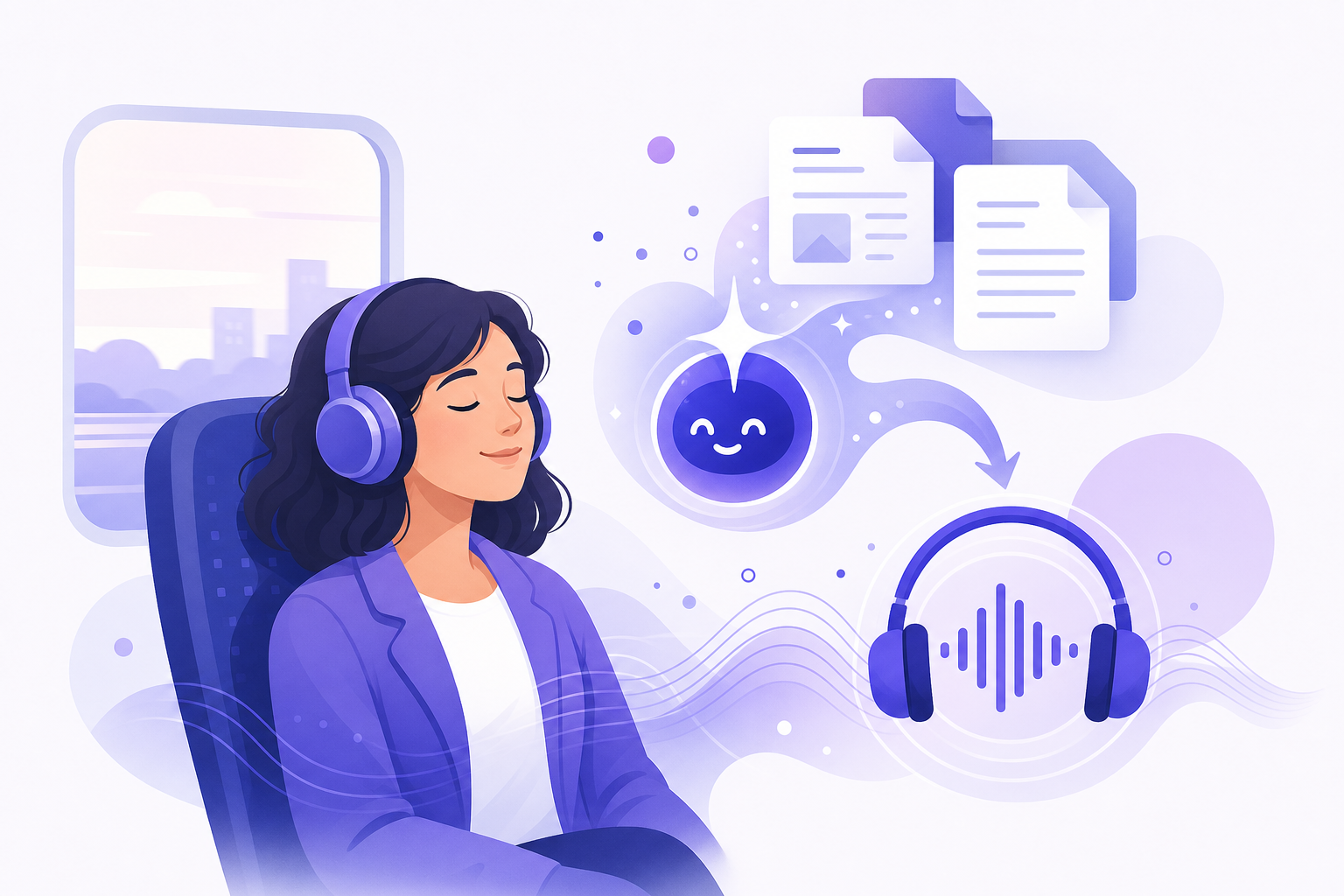
Learning on the go means turning dead time — the commute, waiting at the stop, the walk to the shop — into study time with audio and AI. It works surprisingly well, but not for the reason most people assume: not because listening is a magic shortcut, but because it hands back minutes you would otherwise lose — provided you pair plain listening with short moments of recall and spread your reviews out over time.
What does „learning on the go“ mean — and does it even work?
It covers any form of studying that does not happen at a desk: on the bus, on the train, while walking, cooking, or washing up. The obvious format for this is audio, because it leaves your eyes and hands free. The decisive question is: do you understand and retain material just as well when you hear it as when you read it?
Research gives a reassuring answer. In 2016, Beth Rogowsky and colleagues had 91 adults take in the same nonfiction text either as an audiobook, as e-text, or as both at once, in SAGE Open. Neither immediately afterwards nor two weeks later was there a statistically meaningful difference in comprehension — modality barely mattered.
A large meta-analysis by Virginia Clinton-Lisell (2022), covering 46 studies and nearly 4,700 people, confirms this at its core and sharpens it at the same time: across all the research, reading and listening did not differ reliably (effect size g = 0.07). Reading held a small edge only when readers could set their own pace and when the task involved demanding, inferential comprehension. The practical lesson: for most content, listening is on par with reading — only for very dense, complex material, where you like to jump back repeatedly, does reading pull slightly ahead.
Why is audio so practical for the road?
The real gain lies not in the modality but in the opportunity. An average commute of 30 minutes each way adds up to roughly five hours over a week — time in which your eyes are tied up anyway or gazing out of the window. Audio fills exactly those windows.
On top of that comes a low barrier to entry: headphones in, press play — no desk, no opening of books, no quiet room required. If you tie studying to a fixed habit such as your commute, you don't have to talk yourself into it each day; the trigger is already there. That frictionlessness often decides whether a good intention becomes a routine.
This fits an approach called microlearning: studying in short, self-contained bites of a few minutes. A train ride is rarely enough for a whole chapter, but plenty for one narrated section, a summary, or a handful of repeated facts. That knowledge can be spread across many small units is no drawback — on the contrary, it is part of what makes studying effective.
„I'm an auditory learner“ — is that true?
One widespread misconception deserves to be cleared up here, because it leads people astray especially quickly when audio is involved. Many believe there are fixed „learning types“ — one person learns visually, another aurally, a third through movement — and that you just have to hit the right channel. An influential research review by Harold Pashler and colleagues (2008) found simply no solid basis for this: there are hardly any clean experiments showing that tailoring instruction to a supposed style improves learning.
For learning on the go, that is good news. Audio works not because you are an „ear person,“ but because it unlocks time that would otherwise go unused. So you needn't ask yourself whether listening „suits you“ — it works for virtually all learners, as long as you use it well.
How do you turn mere listening into real learning?
Here is the sore point. Plain listening is passive, and passivity feels more productive than it is. Let an episode run in the background and you will recognise the material afterwards — but often you can't retrieve it from memory. Two well-documented principles from learning research turn listening into reliable learning.
First, active recall. Memory is strengthened above all when you pull it out of your own head rather than merely taking it in again. Applied to listening, that means: mentally hit pause and silently answer a question before the speaker gives the answer. At the end of the trip, ask yourself what the three key points were. It is exactly this brief self-testing that turns listening into learning.
Second, spacing it out over time. The meta-analysis by Nicholas Cepeda and colleagues (2006) in Psychological Bulletin evaluated 317 experiments and found consistently: studying spread across several days clearly beats cramming it into a single session — and the longer you want to retain something, the larger the intervals should be. Your daily commute is ideal for this. Instead of hearing everything once, you re-listen to the same core material spread across several days. This practice is called spaced repetition — distributed review — and is one of the best-evidenced levers there is.
A simple routine for the road:
- Warm up briefly. At the start, recall what you heard last time — before you play on.
- Listen actively. Pause internally and answer questions yourself rather than just consuming.
- Summarise at the end. Sum up in one sentence what stuck.
- Review with spacing. Return to the same material after a day or two — not all in one go.
How far audio really carries, and where its limits lie, is explored in the piece on whether learning with podcasts works. It shows why listening is a good entry point but no substitute for active processing.
Which situations suit it — and which don't?
Not every setting is equally good. Audio works best when your mind is free but your hands or eyes are occupied: on the train, while walking, while washing up. It becomes tricky as soon as the activity itself demands attention. Anyone at the wheel should focus on the traffic; demanding learning and driving compete for the same limited attention, and safety comes first.
For dense, new material where you often want to jump back, a quiet environment is the better fit anyway — this is where the small advantage of self-paced reading from the meta-analysis shows up. On the move, audio therefore plays to its strength in reviewing and consolidating rather than in tackling difficult new ground for the first time. A sensible division of labour: you work through the new at your desk, and take the consolidation with you on the road.
How do you get good audio study material?
Ready-made study podcasts exist on many topics, but they rarely match your material exactly — your lecture, your textbook, your exam focus. That is why it pays to generate audio from your own documents. Two routes are common: you simply have texts read aloud, or you turn a script into a conversational podcast format that is easier to follow by ear. How a PDF becomes something you can listen to is described in detail in the piece on turning a PDF into a podcast.
This is exactly where LearnCastAI comes in: from your own PDFs and notes it creates study podcasts, summaries, and flashcards that you can listen to and quiz yourself on while out and about. If you want to try how your commute turns into study time, the learning on the go page is a starting point. Further methods around learning with AI go deeper into how to combine audio sensibly with summaries, quizzes, and review.
Conclusion
Learning on the go is no miracle cure, but a smart way of handling time. Listening barely trails reading in comprehension, and the real effect appears once you take two proven principles with you: testing yourself while you listen, and reviewing the same material spread across several days. Turn your next trip into five minutes of active review — that is all it takes to make dead time into real progress.
Sources
- Does Modality Matter? The Effects of Reading, Listening, and Dual Modality on Comprehension — SAGE Open (Rogowsky, Calhoun & Tallal, 2016)
- Listening Ears or Reading Eyes: A Meta-Analysis of Reading and Listening Comprehension Comparisons — Review of Educational Research (Clinton-Lisell, 2022)
- Distributed Practice in Verbal Recall Tasks: A Review and Quantitative Synthesis — Psychological Bulletin (Cepeda et al., 2006)
- Learning Styles: Concepts and Evidence — Psychological Science in the Public Interest (Pashler et al., 2008)
Frequently asked questions
For most content, yes. A meta-analysis by Clinton-Lisell (2022) covering 46 studies and nearly 4,700 people found no reliable overall difference (g = 0.07). Reading held only a small edge with self-paced reading and with demanding, inferential comprehension. For reviewing on the go, audio is well suited.
No. There is no robust evidence for fixed learning types (Pashler et al., 2008). Audio works not because it „suits you“ but because it unlocks otherwise unused time — and that works for virtually all learners.
Test yourself while you listen: pause mentally, give an answer silently, and sum up the key points in one sentence at the end. And review the same material spread across several days rather than all at once — that distributed review is the stronger lever.
The gain lies not in the audio format itself but in the opportunity: a 30-minute commute each way adds up to roughly five hours of otherwise unused time per week that audio can fill. On top of that comes a low barrier to entry — headphones in, press play, no desk required — and tying it to a fixed habit like the commute makes it easier to turn into a routine.
It works best when your mind is free but your hands or eyes are occupied — on the train, while walking, or washing up. Behind the wheel, attention should stay on traffic, since demanding learning and driving compete for the same limited attention. For dense, new material where you often want to jump back, a quiet environment is also a better fit than being on the move.
Enjoying LearnCastAI? Tell Google.
 Add as preferred source