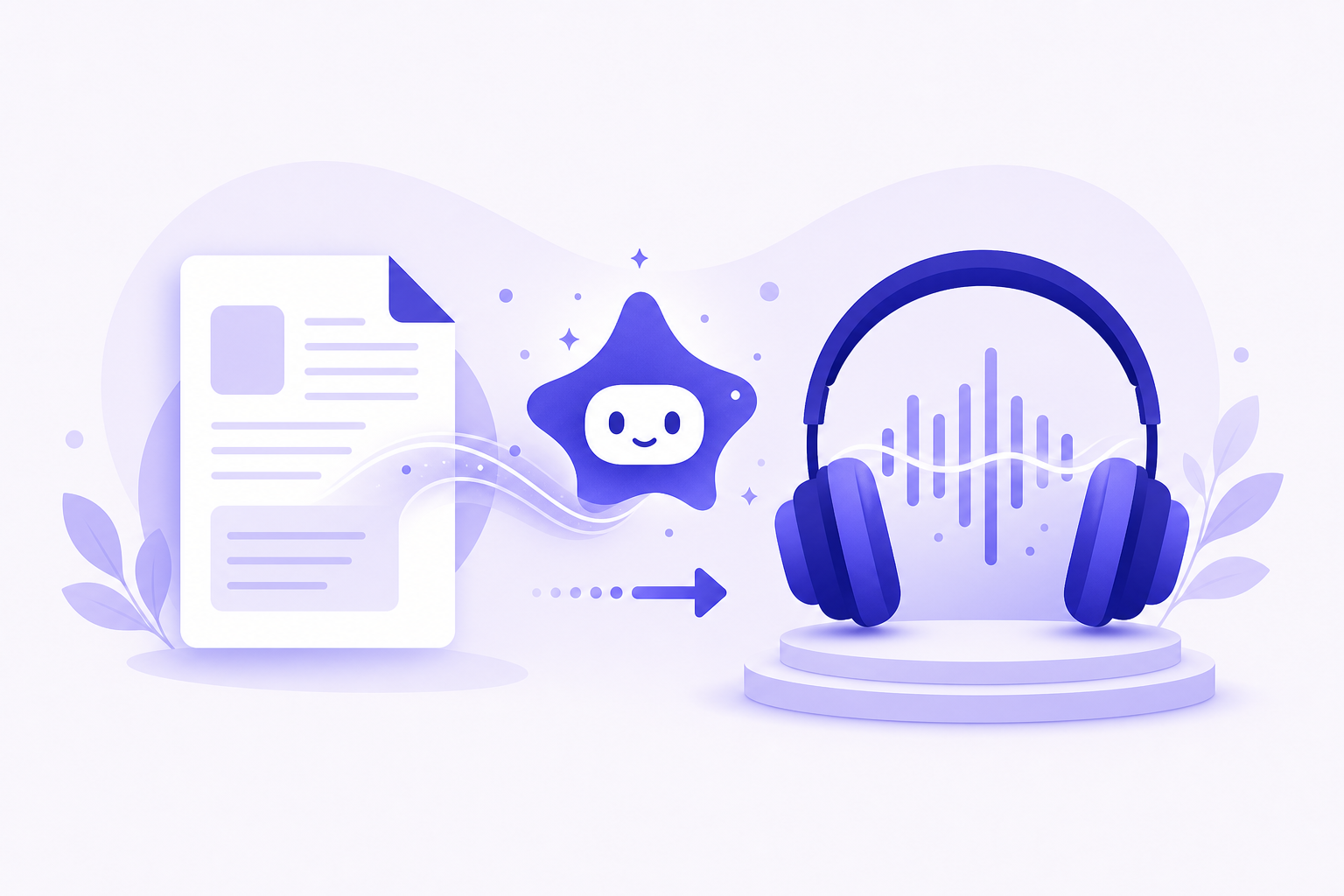
Turning a PDF into a podcast means translating the text of your notes, textbook, or lecture handout into spoken audio – either as a plain read-aloud or as a lively dialogue between two voices. That turns commuting, exercising, or doing chores into usable study time, without having to stare at a screen.
What does "turning a PDF into a podcast" mean?
A PDF is a silent document; a podcast is an audio file you can take anywhere. The conversion closes exactly that gap: software reads the text out of the PDF, prepares it, and generates an audio track from it. In the simplest case, the text is just read aloud. More elaborately, it becomes a conversation in which two voices explain the material, ask questions, and put it in context – just like a real study podcast.
The approach is part of a larger trend of using learning with AI as a tool: instead of reading the same summary yet again, you listen to it – and unlock time slots in which reading wouldn't be possible at all.
How does the conversion work technically?
Two building blocks sit behind it. The first is text-to-speech, the synthetic generation of speech from written text. Modern TTS voices no longer sound tinny but surprisingly natural – with stress, pauses, and sentence melody. The second block is content preparation: a language model summarizes the PDF's content, breaks it into sections, and, if needed, writes a dialogue script that the voices then speak.
A practical snag: not every PDF contains real text. Scanned book pages or photographed notes are often just images. For software to read them aloud, it first has to extract the text from the image using OCR. With clean, digitally created PDFs, this step is unnecessary and the result is usually far more accurate.
For the format, you roughly have two options:
- Read-aloud (1:1): the text is spoken as faithfully as possible. Useful when the exact wording matters – for legal texts, definitions, or quotations.
- Dialogue podcast: two voices discuss the material freely, ask questions, and summarize. This format was popularized by Google's NotebookLM in 2024 with its "Audio Overview" feature, in which, per Google, "two AI hosts" hold a casual "deep dive" about your uploaded sources. How well such a tool works specifically for studying is something we looked at more closely in our piece on NotebookLM as a study tool.
One caveat for the dialogue variant: Google itself notes that the AI voices "sometimes introduce inaccuracies." A generated podcast therefore does not replace the original. It's a starting point that you should check against your own materials before relying on it in an exam.
What are the advantages of listening over silent reading?
Three advantages are especially practical. First, mobility: audio works everywhere reading fails – on the bus, while cooking, while running. Second, a lower barrier to entry: hitting "play" takes less willpower than sitting down with 40 pages of text. That can help you take the first step against procrastination. Third, easy repeatability: you can listen to the same episode a second or third time on the side, without having to sit back down.
These advantages are real, but not a free pass. Whether listening actually pays off in the end depends less on the format than on what happens in your head while you listen.
Do you really learn as well with audio as with reading?
For plain comprehension, surprisingly often yes. A controlled study by Rogowsky, Calhoun, and Tallal (2016) randomly split 91 adults into three groups: some heard a non-fiction chapter as an audiobook, others read it as e-text, and the third did both at the same time. Comprehension was then tested immediately and again after two weeks. The result: "No statistically significant differences were found" – there was no meaningful difference between listening, reading, and both combined.
That doesn't mean listening is always the better choice. It was a single study with adults and a well-structured non-fiction text; with very formula-heavy material like mathematics or chemistry, or when you need diagrams, pure audio quickly hits its limits. But it supports an important point: if you prefer to listen, you generally give up nothing in comprehension. Whether and when audio learning with podcasts pays off depends above all on how attentively you listen – focused or just in the background.
Are there "auditory learners" who benefit especially?
A widespread myth holds that some people are "auditory learners" and therefore have to listen rather than read. There is no solid evidence for this idea. Yale University's Poorvu Center for Teaching and Learning sums up the research this way: "There is no evidence that supports teaching to a person's specified learning style results in better learning." The foundational review on this comes from Pashler and colleagues (2008).
In practice, that means you don't have to figure out first whether you're an "audio type." A study podcast pays off not because you belong to a particular type, but because it unlocks time slots and adds variety – and that helps virtually all learners.
How do you get the most out of podcast learning?
The biggest mistake in audio learning is letting it run purely passively. A podcast in your ears feels productive, but without your own mental effort little sticks. The research is clear here: Roediger and Karpicke (2006) showed that actively retrieving from memory boosts long-term retention far more than mere re-reading – "prior testing produced substantially greater retention than studying." That very retrieval is missing when you just listen.
Here's how to turn passive listening into active learning:
- Set a question first. Briefly consider what you want to take away from the episode. That gives your attention a target.
- Pause deliberately. Stop after a section and restate the core idea in your own words – out loud or in your head.
- Then retrieve, don't re-listen. After the episode, summarize from memory what stuck. Only then fill the gaps with the PDF.
- Repeat with spacing. Don't play the same episode three times in a row, but spread it across several days.
Tools like LearnCastAI's PDF-to-podcast converter take the busywork of turning your script into a listenable episode off your hands. But actively engaging with the material stays your job – no tool thinks for you.
Who benefits from turning PDFs into podcasts?
Those who benefit most are people with many "dead" time slots: commuters on the train, students on their way to campus, apprentices while exercising or doing housework. Anyone who wants to spare their eyes after hours in front of a screen also gains a genuine alternative. And for a first overview of a new, extensive topic, a ten-minute dialogue podcast is often a more pleasant entry point than 40 pages in one go.
Pure audio is less suitable where exact formulas, graphics, or the precise interplay of image and text matter. And for memorizing many individual facts – vocabulary, dates, definitions – flashcards with spaced repetition are usually more effective than a podcast running straight through.
It is not only PDFs you can voice: lecture slides and scripts turn into a study podcast from your lecture too, so you can review the material on the go.
Conclusion
Turning a PDF into a podcast is no miracle cure, but a smart way to convert unused time into study time – and comprehension, according to the research, generally doesn't suffer. What matters is how you listen: those who pause, actively retrieve, and repeat with spacing get far more out of each episode than from mere background noise. If you'd like to try it with your own materials, you can turn them into a listenable episode with LearnCastAI in minutes – but the most important part, thinking along, stays with you.
Sources
- NotebookLM now lets you listen to a conversation about your sources (Audio Overviews) — Google (The Keyword blog)
- Does Modality Matter? The Effects of Reading, Listening, and Dual Modality on Comprehension (Rogowsky, Calhoun & Tallal, 2016) — SAGE Open (via ERIC)
- Learning Styles as a Myth — Poorvu Center for Teaching and Learning, Yale University
- Test-Enhanced Learning: Taking Memory Tests Improves Long-Term Retention (Roediger & Karpicke, 2006) — Psychological Science (via PubMed)
Frequently asked questions
You upload the PDF to a tool that reads out the text (running OCR first for scans), prepares it, and outputs it as audio via text-to-speech – either as a plain read-aloud or as a dialogue between two voices.
For plain comprehension, a study by Rogowsky et al. (2016) found no meaningful difference between listening, reading, and both. For formulas, graphics, or rote memorization, reading or active review often still has the edge.
No. Purely passive listening does little. Pause, summarize from memory, and repeat with spacing – active retrieval is, according to research, the real learning moment.
No, there is no solid evidence for that idea. Yale's Poorvu Center sums up the research by noting that teaching to a supposed learning style does not lead to better learning. A study podcast pays off not because of a particular type but because it unlocks unused time slots and adds variety – which helps virtually all learners.
A podcast can be heard anywhere reading isn't possible – on the bus, while exercising, doing chores. Hitting play also takes less willpower than sitting down with a long text, and the same episode can be replayed casually several times. These advantages, though, don't replace actively engaging with the material.
Enjoying LearnCastAI? Tell Google.
 Add as preferred source