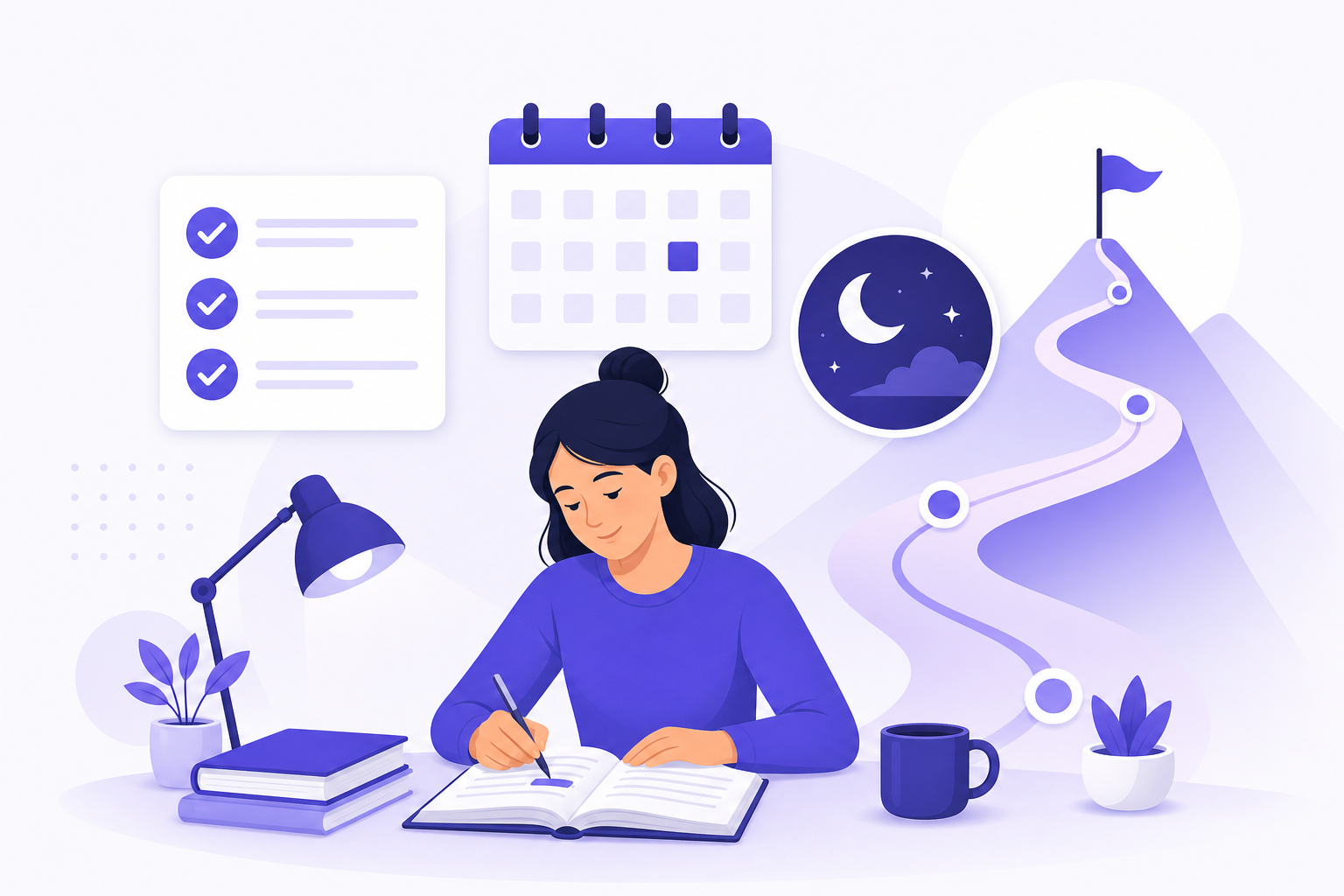
The day before an exam, intensive cramming does little for you. What helps far more is a light, active review of what you have already learned, enough sleep, and a calm, well-organised routine — because learning brand-new material for the first time now mainly costs you nerves and sleep without reliably adding anything.
What should you do the day before an exam?
In short: consolidate rather than start from scratch. The final day is no substitute for the weeks before it — it is the phase in which you secure what you already have and get yourself ready, both mentally and logistically. Three priorities have proven their worth:
- Review lightly and actively: retrieve the key connections from memory instead of rereading everything for hours.
- Get enough sleep: no all-nighter, no race against the alarm clock.
- Calm and logistics: prepare your documents, route and materials in good time so the morning of the exam runs smoothly.
Why exactly these three points matter — and what learning research says about them — is what we will look at, one at a time.
Why does cramming on the last day achieve so little?
Because massed learning — technically "massed practice", colloquially cramming — feels good in the short term but rarely holds up. As you read quickly, the material feels familiar, and many people mistake that familiarity for genuine mastery. Researchers call this a fluency illusion: what reads fluently seems mastered, yet often fades within hours.
The evidence-based counter-strategy is distributed learning, the so-called spacing effect: the same study time spread across several days produces far more durable knowledge than the same time in one block. A large meta-analysis by Cepeda and colleagues (2006, Psychological Bulletin) reviewed hundreds of experiments and confirmed the effect unambiguously — while also showing that the longer you need to remember something later, the wider the gaps between your study sessions should be. John Dunlosky summarises the state of the research in his widely cited review by noting that spaced practice and self-testing are among the two most effective study strategies of all, whereas the feeling of ease during cramming is misleading.
Distributed learning also has a practical advantage: because you waste less time laboriously refreshing what you have already forgotten, it is often even more time-efficient than cramming for the same result. The honest catch: on the day before, you cannot make up for lost ground, because spacing only works in advance. If you want to study regularly over weeks, you will find structure and further guides in our exam preparation category. But even if your preparation was thin, one thing holds: spending the last day desperately learning large amounts of new material for the first time is usually the worst option. It robs you of sleep and confidence — and produces exactly the brittle knowledge most likely to collapse in the exam.
What does "light review" mean — and how do you do it right?
Light review does not mean passive rereading but active recall: you try to remember actively rather than merely recognising the answer. That is precisely the heart of the testing effect. Roediger and Karpicke showed as early as 2006, and Dunlosky's review confirms it, that testing yourself consolidates knowledge far more strongly than simply rereading — especially for recall days later, which is exactly the exam situation.
Concretely, for the day before, that means:
- Summarise from memory: close your materials and write out the key points of a topic freely. Every gap immediately shows you where a quick glance is worthwhile.
- Go through flashcards or quiz questions in moderation — as a targeted self-test, not an hours-long marathon.
- Focus on what matters most: the central concepts, formulas and lines of argument, not every minor detail.
Feel free to switch between different topics rather than repeating a single one for hours — it keeps your attention fresh and exposes weak spots more broadly. Dosage is decisive. A few concentrated, active rounds consolidate and build confidence — whereas working through material for hours on the last day only exhausts you and pushes your nervousness up. Digital tools like LearnCastAI, which turn your own material into flashcards and quiz questions, can make such short self-tests easier; but the actual retrieval from memory is on you — that is precisely where the benefit lies.
How important is sleep the night before an exam?
More important than another chapter — but perhaps in a different way than you think. A study by Okano and colleagues (2019, npj Science of Learning) gave students sleep trackers and compared their sleep data with their exam results. The finding: better sleep quality, longer sleep duration and greater consistency were clearly associated with better grades. Together, the sleep measures accounted for nearly a quarter of the differences in performance — a remarkably large share.
The finding that is surprising for our topic: of all things, sleep on the single night directly before an exam showed no statistical relationship with the result. What mattered was sleep across the weeks and the month beforehand. So a good grade cannot be "bought" with one well-rested night if the time before it was marked by sleep deprivation.
None of this is a licence for an all-nighter, though — quite the opposite. Whoever crams through the last night trades a brittle short-term gain for an exhausted exam day with weaker concentration and attention. The sensible lesson is therefore twofold: ensure regular sleep throughout the whole preparation phase — and treat yourself to a normal, sufficient amount on the final night too. (This is general study guidance, not medical advice; for persistent sleep problems, seeing a doctor is the right course.)
How do you stay calm the day before an exam?
By opening as few new construction sites in your head as possible. Unfamiliar material shortly before the exam mainly creates the feeling of "not being able to do all this yet" — and that fuels nervousness without reliably contributing to the result. A few principles help you stay calm:
- No new material: the day before is for consolidating, not for learning entire chapters from scratch.
- Prepare the logistics: sort out your ID, pens, calculator, route and time in advance. Every bit of morning panic you avoid saves nerves for the exam itself.
- Switch off deliberately: exercise, a walk or something relaxing in the evening does more good than the tenth repetition of the same page.
If you notice the tension getting the upper hand, you will find concrete techniques in our piece on how to overcome test anxiety. And if your worry is above all about the dreaded blank, the guide on how to avoid an exam blackout helps — well-rested and calm, its likelihood is already considerably lower anyway.
Which mistakes should you avoid the day before?
- Cramming late into the night. The short-term gain is small, and the price — tiredness on exam day — is high.
- Learning completely new material for the first time. It is stored brittly and unsettles you more than it helps.
- Only rereading and highlighting passively. That creates familiarity but little genuine retrieval.
- Winding each other up about how hard it will be. That raises stress, not knowledge.
Your plan for the day before the exam
- Review briefly and actively in the morning — retrieve the most important topics from memory and close small gaps in a targeted way.
- Finish early with your studying; no marathon into the night.
- Handle the logistics — prepare documents, route and alarm.
- Schedule exercise and a break in the afternoon or evening.
- Sleep normally and sufficiently — go to bed at your usual time.
Conclusion: consolidate, sleep, stay calm
The day before an exam is not an emergency study day but the moment in which you secure what you already have and get yourself ready. Light, active review beats frantic cramming; regular sleep beats the all-nighter; calm and good logistics beat panic. Anyone who knows these three priorities walks into the exam room the next morning more alert and more composed.
If you want to set your preparation on a solid footing from the start, LearnCastAI for exam preparation offers tools that turn your own material into summaries, flashcards and quiz questions — so that the light review on the last day is genuinely light.
Sources
- Sleep quality, duration, and consistency are associated with better academic performance in college students — npj Science of Learning (Okano et al., 2019)
- Strengthening the Student Toolbox: Study Strategies to Boost Learning — American Educator (John Dunlosky, 2013)
- Distributed practice in verbal recall tasks: A review and quantitative synthesis — Psychological Bulletin (Cepeda et al., 2006)
Frequently asked questions
Yes, but only lightly and actively: retrieve the key content from memory and close small gaps in a targeted way. Cramming new material for the first time is barely worth it and comes at the cost of sleep and calm.
An all-nighter is a poor idea: it trades a brittle short-term gain for weaker concentration on exam day. According to Okano et al. (2019), what matters most is sleep over the preceding weeks anyway, not the single night.
A few concentrated, active rounds are enough: summarise from memory and use flashcards or quiz questions as a self-test. Working through material for hours only exhausts you and increases nervousness.
The fluency illusion describes how material feels familiar and therefore mastered when you read it quickly, even though it often isn't — that familiarity frequently fades within hours. Genuine mastery only shows when you retrieve the answer from memory without looking at the text. That's why plain rereading the day before achieves far less than active recall.
The day before, sort out your ID, pens, calculator, route and timing so the morning of the exam runs smoothly. Every bit of morning panic you avoid saves nerves that would otherwise be pulled away from the exam itself. On top of that, deliberately switching off in the evening, say with a walk, helps more than one more round of review.
Enjoying LearnCastAI? Tell Google.
 Add as preferred source